
Great customer service training teaches people how to understand customers, communicate clearly, take ownership and create memorable experiences.
It shouldn’t need to change who people are. It should give them ideas and tools to help them become even better.
I’m the UK’s best-selling British author on customer service and my core belief is most people want to provide great service. The challenge comes when they are busy, distracted or simply don’t know what good looks like. Great training helps people recognise the moments where they can make a difference and where their behaviour has the greatest impact.
Notice the customer
Customer service begins before the customer asks for anything. One of the simplest techniques I teach is to:
See. Smile. Say hello.
- See the customer, before they see you
- Smile, before they smile at you
- Say hello, before they say hello to you
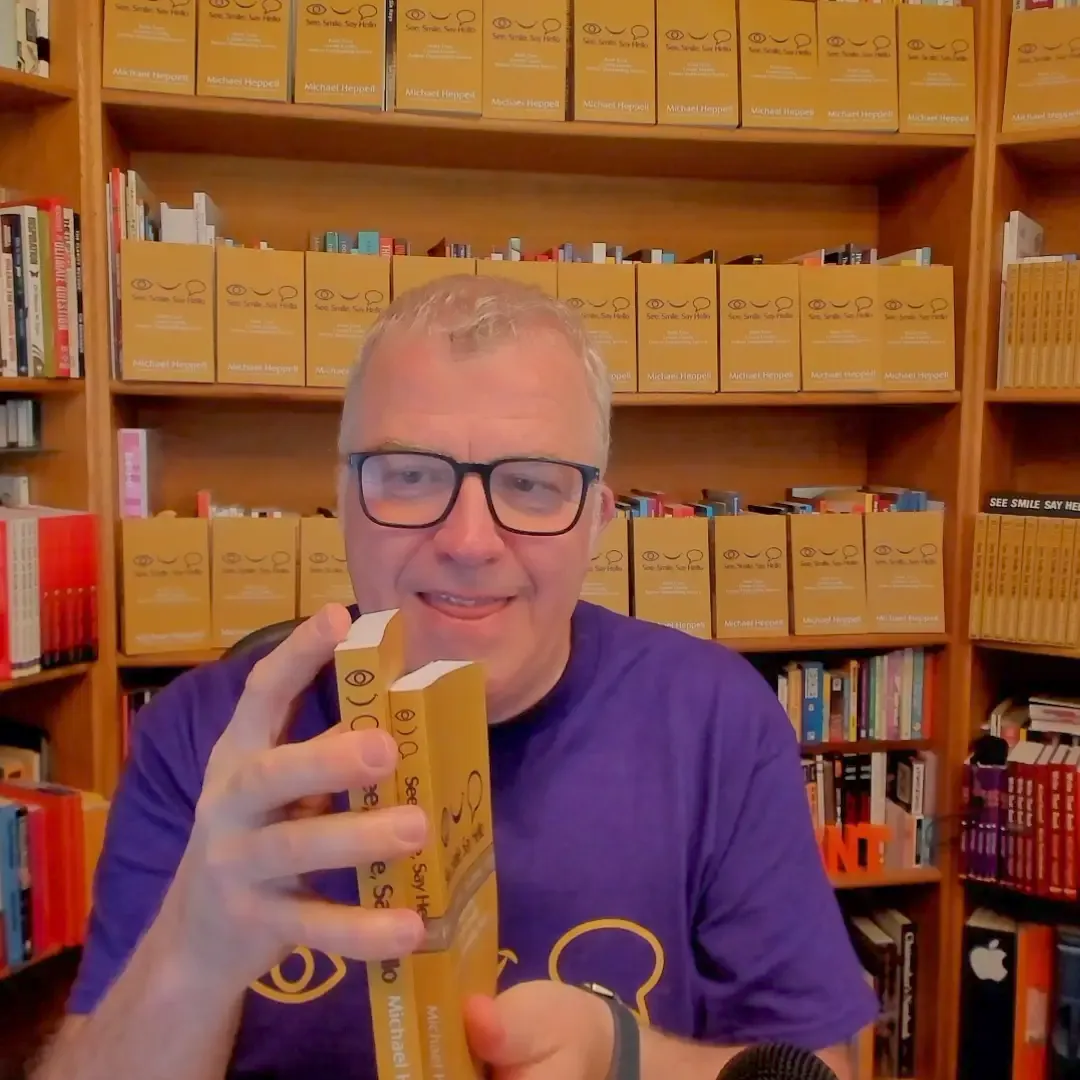
It sounds obvious, yet these three simple steps are often missed. I wrote a whole book on them!
You’ve experienced it where you walk into a business and the staff continues typing, talking or looking at a screen. Nobody acknowledges you. After a few seconds, you, their customer, begin to wonder whether anyone has noticed and the countdown begins. I’ll give them ten seconds, then I’m out!
You may not be able to serve someone immediately, but you can always acknowledge them.
‘Hello. I’ll be with you in just a moment.’
That simple sentence can change a moment into an experience.
Understand what the customer truly needs
Customers don’t always say exactly what they need.
Someone asking when an order will arrive may be worried that it won’t be there for an important birthday.
A person complaining about a mistake may want to know they have been listened to and taken seriously.
Great customer service training teaches people to listen beyond the first question. It should empower them to act and give them the confidence to ask follow-up questions.
Useful questions include:
- ‘What would be most helpful for you now?’
- ‘Is that what you were hoping for?’
- ‘Is there anything else I can do for you?’
The better you understand your customer, the easier it is to provide the right response.
Communicate clearly
Many customer service problems begin with vague or confusing communication.
I teach something called Time Speak.
‘It should be with you soon’ is not as useful as, ‘It will be with you before 3pm tomorrow.’
‘Someone will call you back’ leaves the customer wondering who will call and when.
A clearer message would be:
‘Sarah will call you before midday tomorrow. If you haven’t heard from her by then, please contact me directly.’
Specific information creates confidence. Jargon, abbreviations and poorly written scripts create distance.
Customers shouldn’t need specialist knowledge just to understand what’s happening.
Tone is huge too.
Compare:
‘You have completed the form incorrectly.’
With:
‘One part of the form still needs to be completed. Let me show you which one.’
The information is similar. The experience isn’t.
Teach people to take ownership
Customers don’t care which department caused the problem. They just want someone to help them solve it.
And while nobody would ever say, ‘That’s not my job’, would they?
There is still a huge difference between:
‘That isn’t my department.’
And:
‘I’m not the best person to answer that, but I’ll find someone who is.’
Taking ownership doesn’t mean doing everything yourself.
It could involve making an introduction, explaining the next step or checking that the issue has been resolved.
The customer should never be abandoned or sent away to start again.
Organisations sometimes make customers work far too hard. They are passed between departments, asked to repeat information and expected to understand internal systems.
Great customer service should always make things easier.
Handle complaints with confidence
A complaint is an opportunity to discover what has gone wrong and put it right.
People often become defensive when faced with an unhappy customer. Good training gives them a simple process to follow:
- Listen without interrupting.
- Acknowledge the frustration.
- Clarify what has happened.
- Apologise appropriately.
- Explain what can be done.
- Agree the next step.
- Follow up.
A genuine apology can quickly change the tone of a conversation.
‘That’s horrible. I’m sorry this has happened. I can understand why you are disappointed.’
The apology should then be followed by action.
Customers don’t just want sympathy. Nor do they always want to be asked what they would like to happen. They want you to be able to take control and fix it. They want to feel understood and know what will happen next.
Create memorable moments
Five-star service doesn’t need to be expensive.
It could be:
- remembering a customer’s name
- walking someone to the correct place instead of pointing
- calling to check that a problem has been solved
- noticing someone needs help before they ask
- writing a short personal note
One of the most popular chapters in my book 5 Star Service introduces the concept of Wee WOWs.
These are small actions you can do regularly that put deposits into the customer’s emotional bank account.
They’re memorable because they feel personal.
A customer knows when someone has noticed, listened and made an effort.
Training should encourage people to look for opportunities to create Wee WOWs rather than wait for a problem to occur.
Make sure the training lasts
A single training session will not transform customer service. Sorry.
The real test comes when people return to work. Real life.
- Do managers model the behaviour?
- Are examples of great service shared?
- Are people recognised when they go the extra mile?
- Are complaints discussed so the organisation can learn from them?
Leaders set the standard through their own actions.
If a manager ignores a waiting customer, the team will notice.
If a leader steps in and helps, they will notice that too.
Customer service becomes part of the culture when it is demonstrated, discussed and recognised regularly.
What should people learn from customer service training?
At its most basic level, a strong programme should help people:
- notice and acknowledge customers quickly
- listen carefully and ask useful questions
- understand practical and emotional needs
- communicate clearly
- set honest expectations
- take ownership
- handle complaints calmly
- create personal and memorable moments
Customer service is not only the responsibility of a particular team or department.
It is a series of choices made throughout the day.
The choice to notice.
The choice to listen.
The choice to help.
The choice to make things easier.
Great customer service rarely comes from one spectacular gesture. It comes from doing small, thoughtful actions brilliantly and consistently.
Michael Heppell is a customer service speaker and trainer. He is the author of 5 Star Service and See, Smile, Say Hello. He works with organisations that want to create brilliant customer experiences and make great service part of everyday behaviour. If that is what you are looking for, see in-house training.


Comments